Most crypto scam victims never report their loss.
Research from the Australian Institute of Criminology (AIC) and the Australian Competition and Consumer Commission (ACCC) shows a consistent pattern: most victims of cybercrime, including crypto scams, never formally report what happened.
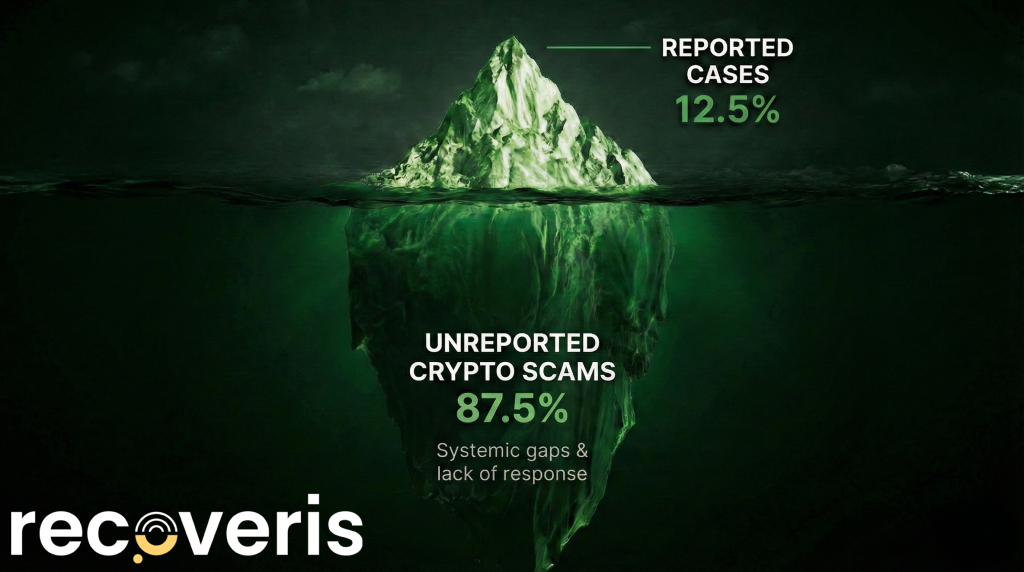
The AIC’s nationally representative cybercrime survey indicates that only around 12.5% of fraud and scam victims report incidents to authorities such as police or ReportCyber. In other words, approximately 87.5% of fraud and scam incidents, including crypto scams, remain unreported.
The ACCC’s Targeting Scams work points in the same direction. In their 2021 analysis, 20% of survey respondents reported being scammed in the previous five years, but:
- about 30% did not report to anyone at all
- only 13% reported to Scamwatch
- many cases never reached any formal institution
Combined with AIC’s finding that roughly 90% of cybercrimes go unreported, the conclusion is clear. Crypto crime is massively underreported, and the data we see is only the visible part of a much larger problem.
Why victims of crypto scams stay silent
The research identifies several recurring reasons why victims do not come forward. These reasons align closely with what we see in our daily work with victims of stolen cryptocurrency and investment fraud.
1. Victims believe they should handle it themselves
The AIC survey shows that “self-handling” is the most common response. Instead of reaching out to law enforcement or specialized investigators, victims try to manage the situation on their own.
Typical patterns include:
- searching for information online and experimenting with block explorers
- contacting exchanges or platforms without structured evidence
- turning to unverified “recovery” services that later turn out to be scams themselves
For complex crypto fraud and cross-chain laundering, this often leads to dead ends. The case becomes more complicated to investigate later, and the victim remains isolated.
2. Shame and fear of judgment
Although not always labelled directly as “shame” in the survey instruments, our case experience and the broader scam literature show that emotional barriers are significant. Many victims:
- feel embarrassed for “falling for it,” especially if they consider themselves financially or technically savvy
- worry that friends, family, or even professionals will judge them
- underestimate how common victimization actually is
When someone has lost their savings or a significant portion of their assets to an online “investment” or romance-related crypto scam, the psychological impact can be as heavy as the financial loss. This often leads to silence, even when technical recovery options still exist.
3. Perceived non-seriousness or futility
The AIC research highlights another key reason for not reporting: victims think authorities cannot or will not act, especially in digital and cross-border environments.
Specific concerns include:
- “The police will not understand crypto.”
- “It was my mistake, so no one will help.”
- “The scammers are overseas, so nothing can be done.”
From an investigative perspective, some of these assumptions are understandable. Many traditional reporting channels were not originally designed for blockchain-specific cases, and specialist capacity varies widely between jurisdictions. However, the perception that “nothing can be done” is often stronger than the actual limitations.
4. Unawareness of effective options
The ACCC’s work shows that a significant share of scam victims do not know where to report or what the available routes are. Fragmented reporting channels (banks, national scam portals, police, regulators) make the process harder to navigate.
For crypto-specific cases, the situation is even more complex:
- the victim may not know that blockchain forensics can trace assets even after multiple hops
- they may not realize that forensic reports can support law enforcement and civil proceedings
- they may be unaware that some exchanges, payment providers, or VASPs respond to well-documented legal requests
This lack of clear, trusted pathways keeps many victims in a state of inaction.
Underreporting turns into a systemic problem
Low reporting rates are not only an individual issue. They also distort the way institutions see crypto crime.
When around 90% of cyber incidents are not reported, and when crypto-related investment scams generate hundreds of millions of dollars in registered losses (for example, over 177 million AUD in crypto losses recorded in Australia in a single year), the numbers used for planning and resourcing are unavoidably incomplete.
This leads to a feedback loop:
- underreporting makes the problem look smaller than it is
- limited data leads to limited resources and specialist training
- victims experience slow or ineffective responses
- this reinforces the belief that reporting is pointless
Breaking this cycle requires both better individual guidance for victims and more systematic investigative capacity on the institutional side.
What if your stolen crypto was never reported?
If you have already been scammed, have not reported it, and have not taken any structured action, you are not alone. Based on the research and on thousands of cases handled globally by professional investigators, your situation is typical, not exceptional.
Not reporting immediately does not automatically mean that all options are lost. In many cases, it is still possible to:
- reconstruct what happened on-chain
- identify destination wallets, intermediaries, services, or exchanges involved
- generate intelligence that can support legal, civil, or regulatory action
The key difference is whether you proceed with improvised, one-off attempts, or with a structured, evidence-based approach.
How specialized crypto investigations change what is possible
General-purpose reporting systems and non-specialist support teams are often not designed for cross-chain tracing, mixer analysis, or complex investment fraud schemes involving multiple platforms.
Specialized blockchain investigations can:
- trace funds through multiple hops, bridges, and services
- cluster related wallets and identify risk patterns
- prepare documentation that meets evidentiary standards for law enforcement, courts, or compliance teams
This does not guarantee recovery, and responsible professionals will not promise that every case can be resolved. What it does is turn an unstructured, emotionally overwhelming situation into a systematic process with clear steps, timelines, and decision points.
How Recoveris works with silent or late-reporting victims
At Recoveris, we regularly work with victims who:
- did not report their case initially
- waited weeks or months due to shame or uncertainty
- tried to solve the problem alone and then realized they needed specialist help
Our investigations team combines blockchain forensics, cross-chain analysis, and structured evidence preparation. We do not replace law enforcement. Instead, we generate the kind of intelligence that authorities, lawyers, and compliance teams can act on.
For individual victims, this usually involves:
- reconstructing the incident across all wallets, platforms, and chains involved
- identifying key counterparties and potential choke points (for example, exchanges or off-ramps)
- preparing documentation that can support police reports, legal claims, or negotiation with service providers
We are careful to avoid unrealistic promises. Outcomes depend on many factors, including jurisdictional cooperation, timing, and enforcement capacity. What we provide is a methodical approach and expertise where victims typically feel they have none.
Building systems so victims can believe that help is possible
Working on individual cases is only part of the solution. The research is clear: as long as most victims feel that reporting is pointless, underreporting will continue.
This is why we are expanding beyond human-led investigations into scalable investigation infrastructure.
BIMS: investigation workflows at scale
Recoveris is developing BIMS (Blockchain Investigations Management System), an AI-enhanced platform designed to:
- support law enforcement, compliance teams, and asset recovery specialists
- centralize the investigative lifecycle, from tracing and monitoring to evidence management
- integrate cross-chain analytics with standardized reporting frameworks
The goal is to give institutions a practical way to handle more cases, more consistently, and with better documentation. When response systems become more effective and crypto-native, victims gain a realistic reason to report.
Working with state authorities and regulators
We actively share our methodologies with public institutions. For example:
- our CEO, Marcin Zarakowski, and Head of Product, Roman Bieda, recently presented to the Polish Parliamentary Commission for Crypto Assets and Blockchain Technology, outlining how to build effective responses to crypto scams
- our team members contribute as experts in law enforcement training programs in various countries, including work with international organizations such as the OSCE
- we maintain ongoing dialogue with agencies in multiple jurisdictions on how to improve investigative procedures, technology deployment, and cross-border coordination
The objective is consistent: help regulators, prosecutors, and police move from ad hoc handling of crypto crime to structured, repeatable, and technology-supported processes.
If you have been scammed and have not reported it yet
Feeling ashamed or believing that “nothing can be done” is understandable, but it does not have to be the end of the story.
Key points to keep in mind:
- you are not alone, most victims do not report initially
- silence helps offenders, not you
- specialized investigations can often generate meaningful intelligence even after delays
- a structured approach can support law enforcement and legal action, instead of replacing it
If you have lost digital assets to a scam or theft and are unsure what to do next, you can schedule a confidential consultation with the Recoveris investigations team at https://recoveris.io/schedule-a-consultation.
We will review the situation, assess whether an investigation is viable, and outline realistic next steps. There is no obligation to proceed, and the discussion is conducted with full understanding of how difficult it is to talk about these losses.
Related resources
For further context and official data referenced in this article:
- Australian Institute of Criminology, “Cybercrime in Australia 2024”
- ACCC, “Targeting Scams: Report of the ACCC on Scam Activity 2021”
- CryptoSafety (for English-speaking users): https://cryptosafety.io
- Bezpieczne Krypto (for Polish-speaking users): https://bezpiecznekrypto.pl
Disclaimer
This article is for informational purposes only and does not constitute legal advice, financial advice, or a guarantee of recovery outcomes. Each case depends on its specific facts, the jurisdictions involved, and the actions of third parties such as law enforcement, regulators, and service providers.