The narrative surrounding AI in financial crime often centers on deepfakes and automated phishing emails. But a much more profound shift is occurring on-chain: the rise of autonomous execution. We are entering an era where AI agents – software holding signing authority over wallets – can independently execute transactions, rebalance liquidity, and route funds across decentralized protocols without any human intervention.
When software becomes a transactional actor, the timeline for money laundering compresses drastically. The “layering” stage, traditionally the most operationally intensive part of laundering, can now be executed programmatically. An autonomous agent can fragment stolen funds across dozens of addresses, swap assets through liquidity pools, and bridge them across multiple blockchains in a matter of seconds. In 2025, during high-impact security breaches, funds were observed moving in as little as two seconds, shrinking the window for compliance teams to execute a manual freeze to just minutes. (Sources: TRM Labs Autonomous AI Agents and Financial Crime 2026, Global Ledger Hack Report)
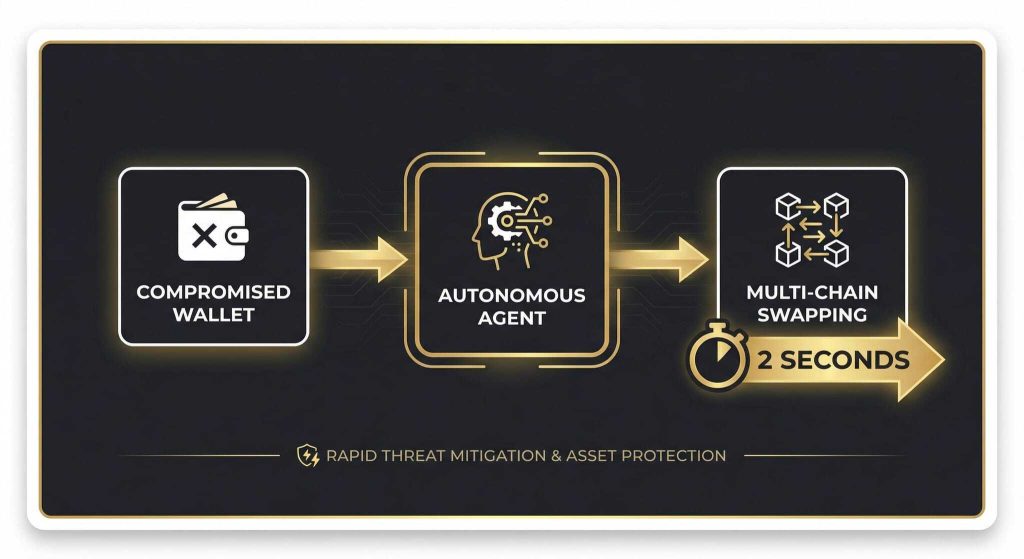
In our experience, distinguishing between a human operator and an automated script is critical to the early stages of a successful recovery operation.
“There are clear behavioral patterns that indicate a script or autonomous agent is executing the transfers rather than a human,” notes Umberto Buonora, Head of Investigations at Recoveris. “We look for assets moving out just seconds after being received, schematic patterns with identical hop counts or percentages, and the mass deployment of ‘fresh’ wallets that would take a human operator significant time to set up. There is an emerging trend for super-fast and intense layering—interacting with decentralized services continuously, which makes it incredibly difficult to follow the assets in real-time.”
This programmatic execution is not just for laundering; it is poised to become a primary vector for market manipulation.
“Looking ahead, AI agents could heavily influence token markets,” predicts Dominik Konopacki, Blockchain Investigations Manager at Recoveris. “We anticipate scenarios where hundreds of coordinated agents simulate market-making on low-cap tokens, generating artificial price movements to attract retail investors before the perpetrators execute a sudden rug pull.”
“I completely agree, and the threat of hyper-fast, automated rug pulls is something we will see materialize very quickly,” adds Dawid Koperski, Blockchain Investigations Manager. “We are already seeing complex layering of stolen assets across multiple blockchains. Threat actors are executing numerous swaps between stablecoins that look entirely automatic and highly organized—a pattern that has clearly emerged over the past few weeks.”
For legal professionals, law enforcement, and institutional compliance teams, the strategic asymmetry is clear: criminals are leveraging machine-speed automation, while defenders are often constrained by manual workflows and legacy investigative tools. Human investigators simply cannot manually click through block explorers or synthesize heterogeneous API data fast enough to catch an autonomous agent.
“Tracking cross-chain transfers is incredibly labor-intensive, especially when bridging services are not yet attributed and we have to figure out exactly which bridge was used,” Dawid Koperski notes. “Preparing full forensic reports requires a massive amount of manual work, triple-checking data, and constantly monitoring for new activity.”
To stay ahead, the investigative landscape must shift to an “AI vs. AI” footing. At Recoveris, this is the foundational architecture of our Blockchain Investigations Management System (BIMS).
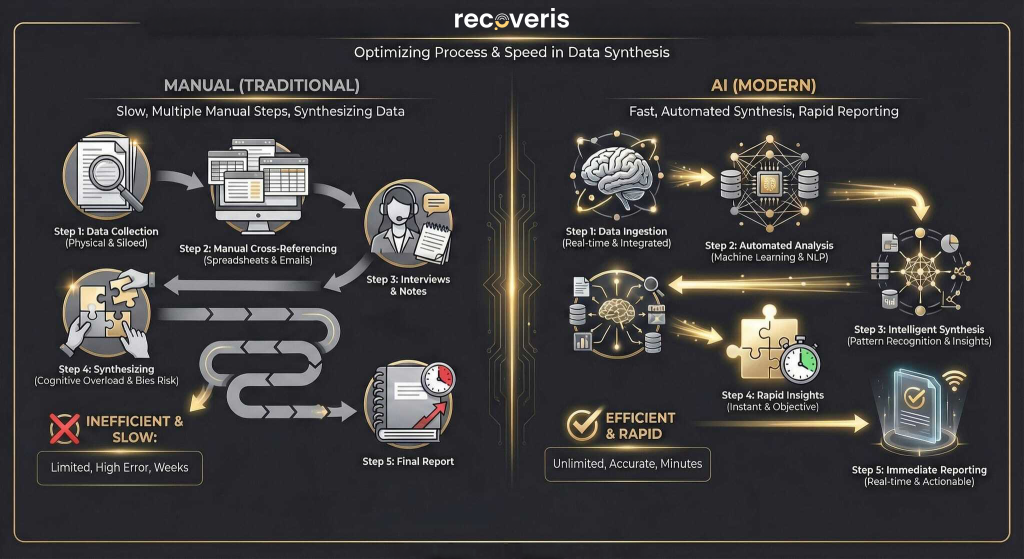
“Investigators must accelerate their workflows by adopting AI,” Dominik Konopacki emphasizes. “In our daily operations, the most time-consuming tasks involve analyzing massive datasets and pulling heterogeneous data from multiple APIs with entirely different schemas. AI provides vital support by cross-verifying our tracing results, catching human errors, and helping draft the final forensic reports. If criminals are using AI, investigators must use it even more effectively to stay one step ahead.”
By automating the synthesis of complex cross-chain data and standardizing court-admissible reporting, Recoveris is equipping the tokenized economy with the vendor-neutral operating system required to combat autonomous financial crime at scale.
Protect your organization from autonomous threats with intelligence-driven solutions. Contact Recoveris today – https://recoveris.io/schedule-a-consultation