As digital asset compliance requirements tighten globally, Source of Funds (SOF) investigations have become critical gatekeepers for institutional onboarding, regulatory compliance, and legal proceedings. Commercial blockchain analytics solutions provide valuable initial insights but typically only highlight close interactions with identified entities, offering automated risk scores that are inherently limited in scope and methodology.
The critical question isn’t whether these tools work, because they do to some extent. The question is: what level of risk are you comfortable accepting when your SOF analysis stops at a bridge with potentially sanctioned entities on the other side?
At Recoveris, we’ve developed methodologies that go beyond automated reports to deliver the comprehensive intelligence that complex cases demand. Our approach combines advanced forensic techniques with systematic documentation to provide the complete SOF picture that institutions, legal teams, compliance officers, individual clients, and companies require. This includes everything from personal wealth verification to corporate investor due diligence.
The Hidden Gaps in Automated SOF Analysis
1. Multi-Chain Asset Movements: Where Tools Hit Their Limits
Current blockchain analytics tools excel at single-chain analysis. Many claim bridge tracing capabilities, but these features are limited in practice, leaving some cross-chain portions unanalyzed, which is a critical gap when modern crypto users routinely bridge assets across multiple networks. As Roman Bieda, our Head of Investigations notes, “These tools either require numerous separate checks for each asset type, or when they attempt unified visualization, the aggregated view becomes too complex to provide actionable insights.”
The reality is that when funds move from Ethereum to Polygon via a decentralized bridge, then to Binance Smart Chain, and finally to a centralized exchange, automated tools often lose the trail at the first bridge. This leaves compliance teams with an incomplete picture and unquantified risk.
2. Privacy Coins and Mixing Services: The Burden of Proof Challenge
Privacy coins present a unique compliance challenge. As Umberto Buonora from our forensic team emphasizes: “Use of privacy coins is a risk factor itself and automatically makes funds dirty.” When Monero or Zcash appears in a transaction chain, the burden of proof shifts entirely to the asset holder.
Financial institutions often treat any privacy coin exposure as an automatic high-risk flag or grounds for rejection. Without comprehensive documentation of pre-privacy coin sources, users face significant onboarding obstacles.
3. Exchange Operations: The Black Box Problem
Commercial blockchain analytics tools can identify that funds originated from Binance or Coinbase, but they can’t analyze what happened within those platforms. Our investigators consistently find that SOF analysis includes reviewing and analyzing internal exchange records which of course is not supported with any tool.
Understanding whether funds came from legitimate trading, P2P transactions with high-risk counterparties, or other sources requires manual analysis of exchange records – something no automated tool can provide.
4. DeFi Complexity: Beyond Simple Token Swaps
The DeFi ecosystem has introduced unprecedented complexity in fund flows. Yield farming, liquidity provision, arbitrage, flash loans, and token airdrops create intricate financial patterns that automated tools struggle to decode.
When a user claims their wealth came from DeFi trading, proving this requires detailed analysis of:
- Yield farming strategies across multiple protocols
- Arbitrage profits between DEXs
- Liquidation events and their proceeds
- Airdrop eligibility and distribution
- Staking rewards and compound interest calculations
5. Time-Sensitive Legacy Cases
Many high-net-worth crypto holders acquired their assets in the early days of Bitcoin and Ethereum. Our team frequently encounters very old cases where the client can’t remember where he got the funds, combined with defunct exchanges, lost records, and pre-KYC era transactions.
6. Cross-Border Regulatory Complexity
While blockchain is borderless, compliance isn’t. Different jurisdictions have varying requirements for SOF documentation, creating a maze of regulatory standards that must be navigated carefully.
The Recoveris Methodology: Systematic Intelligence Beyond Automation
1. Comprehensive Cross-Chain Correlation
Our approach begins where automated tools stop. We employ:
- Manual transaction decoding to verify cross-chain transactions with 100% certainty, with correlation techniques applied when decoding isn’t possible
- Advanced analysis algorithms for cross-chain transfers, including transaction log analysis, payload decoding, and probabilistic matching based on timing, amounts, and behavioral patterns
- Multi-signature wallet analysis across different blockchain protocols
As our investigators explain: “Sometimes you need to correlate transactions (input = output, by datetime, amount, asset, etc.) which is a pure probabilistic approach.”
2. Deep Exchange Record Analysis
We go beyond surface-level exchange identification to provide:
- Internal transaction history review to identify initial funding sources and compiling these off-chain internal records with on-chain data in a standardized way to provide a full picture
- P2P transaction counterparty analysis
- Trading pattern verification to confirm claimed profits
- Cross-exchange fund flow mapping when users utilize multiple platforms
- Internal exchange transfer analysis for off-chain movements between accounts on the same platform
This manual process often reveals critical information: “Sometimes clients provide only one exchange record but then during SOF analysis we can see that they used multiple exchanges which are crucial to prove the source.”
3. Digital Asset Profit Verification
Our team specializes in reconstructing complex DeFi strategies:
- Yield calculation verification across farming protocols
- Arbitrage profit documentation with transaction-level detail
- Liquidity provision return analysis
- Airdrop eligibility verification and distribution tracking
- Flash loan profit attribution
- NFT trading and collection profit analysis
- ICO/IDO participation and token allocation verification
4. Behavioral Pattern Intelligence
Beyond following transactions, we analyze:
- Trading patterns to identify consistent strategies
- Wallet clustering to uncover related addresses
- Timing analysis to verify claimed activities
- Volume patterns to detect anomalies
This often uncovers hidden complexities: “Client may claim to have 1 address with 100 clean BTC, while we identify other addresses belonging to him with dirty BTC.”
5. Privacy Coin Documentation Strategies
When privacy coins appear in SOF chains, we:
- Map all pre-privacy coin transactions comprehensively
- Document legitimate service interactions with KYC verification
- Build alternative evidence chains when direct tracing is impossible
- Prepare burden-of-proof documentation packages for compliance teams
6. Court-Admissible Documentation Standards
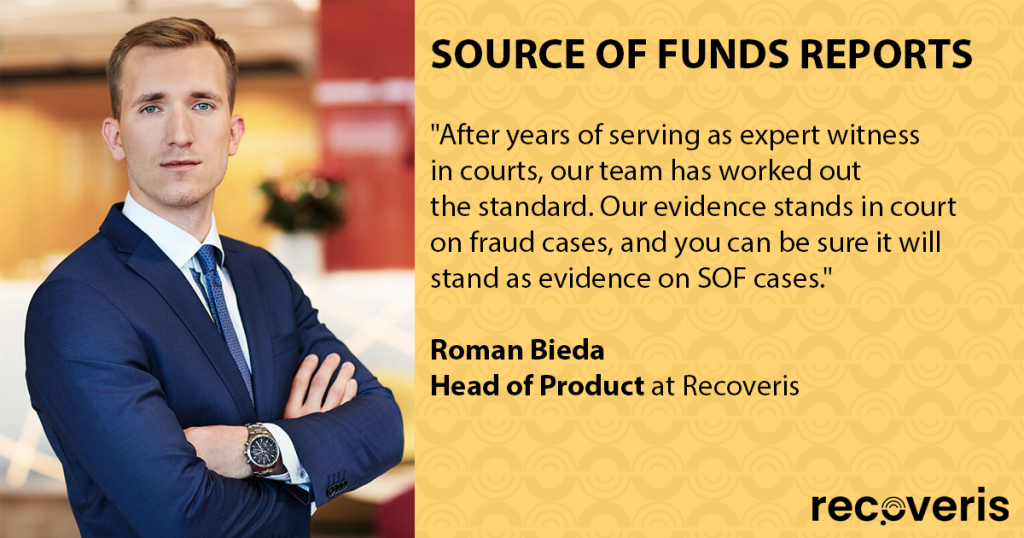
Our reports meet the highest evidentiary standards. Our team notes: “After years of serving as expert witness in courts in US and Europe, we worked out the standard. If our evidence stands in court on fraud cases, you can be sure it will stand as evidence on SOF cases.”
Delivering Actionable Intelligence
Legal-Grade Documentation Framework
Every Recoveris SOF report includes:
- Executive summary with risk ratings and key findings
- Detailed transaction flows with visual mapping
- Evidence preservation with cryptographic proofs
- Technical appendices explained in accessible language
- Compliance-ready formats for various jurisdictions
- Visual representation of profits making with standardized tabular format and clear explanations for clear understanding of wealth making processes
Timeline Considerations
Unlike automated reports generated in minutes, comprehensive SOF investigations require patience. Our investigators note that complex cases can take a longer time because:
- Multiple exchange records must be collected and verified
- Cross-chain correlations require manual validation
- DeFi profits need transaction-by-transaction documentation
- Legacy transactions require extensive OSINT research
Strategic Intelligence Integration
We enhance blockchain data with:
- OSINT research for entity identification
- Public records for corporate verification
- Regulatory databases for compliance checks
- Client-provided documentation validation
When Automated Tools Suffice, And When They Don’t
Automated blockchain analytics tools remain valuable for:
- Quick risk screening
- Simple, single-chain transactions
- Recent transactions with clear exchange origins
- Initial compliance checks
However, specialized forensic expertise becomes essential when:
- Funds cross multiple blockchains
- Privacy coins appear in the transaction history
- Wealth originated from DeFi activities
- Exchange records require detailed analysis
- Legacy transactions lack clear documentation
- Legal proceedings demand court-admissible evidence
The Recoveris Difference
In SOF investigations, the difference between “good enough” and “comprehensive” can determine whether substantial legitimate assets remain frozen or whether compliance approval unlocks critical opportunities. While automated tools provide a starting point, they leave significant gaps that create unquantified risks.
Recoveris bridges these gaps through:
- Methodical investigation that follows funds across any blockchain or protocol
- Technical expertise to decode complex DeFi strategies and cross-chain movements
- Legal-grade documentation that meets the highest evidentiary standards
- Strategic intelligence that transforms raw blockchain data into actionable insights
As the digital asset ecosystem grows more complex, the gap between automated analysis and comprehensive investigation widens. For legal teams, compliance officers, and institutions managing high-stakes SOF requirements, the question isn’t whether to go beyond automated tools – it’s whether you can afford not to.
Need comprehensive Source of Funds intelligence that goes beyond automated reports? Schedule a confidential consultation with our forensic specialists by filling in our contact form.